

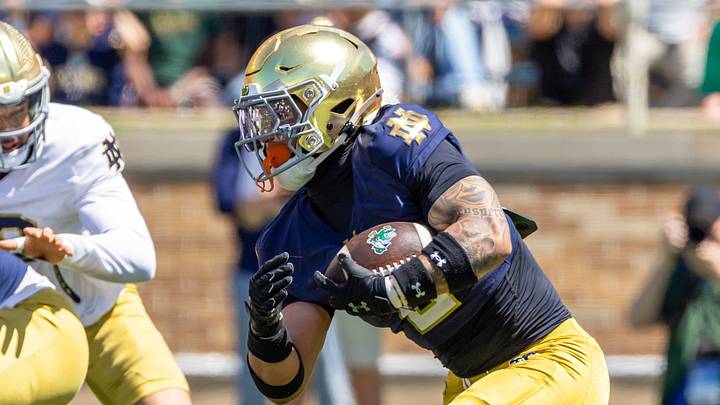
When you clicked on this article, you were probably thinking, "Wait. BYU beating Notre Dame says more about last season than Notre Dame beating BYU? Isn't that a little biased?" I do recognize that there is a tendency among sports fans to emphasize the data points that favor their team and downplay the ones that don't. I also recognize that I'm taking it to a whole new level by justifying that attitude before the game even happens. But I think I have some legitimate arguments.
Last season, even though both BYU and Notre Dame were left out of the playoff, the BYU vs. Notre Dame debate was significant because literally the only argument that Miami had was, "We beat Notre Dame." If BYU would've been ranked ahead of Notre Dame going into champ week, Miami wouldn't have had to jump BYU to also jump Notre Dame, so BYU may have gotten the final spot.
What the argument between BYU and Notre Dame really came down to was this: Which is more important? Looking like the better team or winning more games against better teams? If it was about looking like the better team, I actually think Notre Dame had a strong case. They had the third best average scoring margin in the nation at +24.4 while BYU only had the 27th best at 7.9. Both of Notre Dames losses were in September, while BYU's losses were in November and December. And according to most predictive rankings, including my own, Notre Dame would've been favored to beat BYU on a neutral field.
However, if it's about winning more games against better teams, then there is absolutely no question that BYU was more deserving. Even if you punish BYU the same for losing the Big 12 title game as for any other game, which many argue you shouldn't, BYU still had a better record (11-2) against the 29th strongest schedule in the country, than Notre Dame (10-2) had against the 47th strongest schedule in the country.
(The strength of schedule comes from the ESPN FPI. Notably, these rankings are from the end of the season, meaning they do include the bowl games, but Notre Dame didn't play in a bowl game, and BYU's bowl game against Georgia Tech probably didn't affect their SOS ranking very much one way or the other because 6 of BYU's 13 other games were against teams with a higher FPI ranking than Georgia Tech.)
Now, here's why I think it should only be about your resume and not about which team looks better. In the NFL, seeding in the playoffs is completely based on your record. I like that because it's 100% about what happens on the field and 0% about biased conversations. Now, obviously, we can't do it that way in college football because unlike the NFL, where every team has roughly the same strength of schedule, some teams have significantly stronger schedules than others, and failure to account for that would be incredibly unfair for teams with strong schedules and would discourage teams from scheduling tough games.
But that does not mean that we have to account for things like injuries, style points, eye test, predictive rankings, NFL talent, weighing more recent games more heavily than earlier games, or any of that garbage. If you're trying to determine who the best team is right now, you can't ignore any of those things. But when we let these be the deciding factors in determining who makes the playoff, we make the games into fashion shows instead of football games, we punish teams for things that aren't their fault, and we make the earlier games meaningless.
Plus, if you need evidence that predictive rankings should not be used for determining who makes the playoff, look no further than the fact that last season, after week 1, Texas was number 1 in ESPN's FPI despite losing to Ohio St. The reason for this was that Texas outgained Ohio St by 133 yards, and when you're trying to predict games, you look more at the stats than you do results. But when you're trying to determine who should go to the CFP, it should be about accomplishing the objective of the game, which is to score more points than your opponents, not to gain more yards than your opponent.
So what does this all have to do with what this year's BYU-Notre Dame game proves? Well, if BYU wins, that destroys Notre Dame's argument that they were the better team, especially since both teams have really high returning production rankings, meaning they're both close to the same team they were last year. It would be just like 1985 when BYU beat Washington 31-3, putting to rest the argument that Washington was the better team in 1984 and deserved the national title. But if Notre Dame beats BYU, that does not affect BYU's argument at all because it does not change the fact that BYU still had a better record than Notre Dame against a stronger schedule.
It's like if two people are arguing about whether or not a shape is a square. Lets say one person argues that it's a rectangle and that all rectangles are squares while the other one argues that even if it is a rectangle, not all rectangles are squares. If it turns out that the shape isn't a rectangle, then that completely destroys the first person's argument, but if it is a rectangle, then that doesn't disprove the second person's argument at all.
So if October comes around, and Notre Dame wins, and that annoying Ute fan friend of yours says, "Ha, and you thought BYU was more deserving of the playoff than Notre Dame," remember that the argument for BYU was never about who was the better team. It was about BYU having a better record against a stronger schedule, and nothing that happens this October changes that.
Also, after one of my recent articles, which was about treating the officials like human beings, I've decided that from now on, I'm going to end each article with a reminder to be kind to the officials. Remember to be kind to the officials!
 Add us as a preferred source on Google