

There are only three things that are certain in life: death, taxes, and teams choosing to go on defense when they win the overtime coin toss. In theory, it makes sense. This way, some of your decisions become easier. If your opponent scores a touchdown, everything is four-down territory. If your opponent gets nothing, you play conservative, boring football for three downs and then kick the field goal. Only if your opponent gets a field goal do you really have to make any hard decisions. This is a tangible advantage that you would think would help teams win more than half the time.
But that's not what the data shows. According to a study published by Rick Wilson, which covered every overtime game between 2013 and 2019, in games decided in the first two overtimes, the team that got the ball first in the deciding overtime won 52.7% of the time.
So you should take the ball first. That's the end of the article. As I always say, at the end of every article, remember to... nope, just kidding. It's a lot more complicated than that.
This decade, there have been two coaches who have noticed data like this and have responded by consistently electing to go on offense first: Houston's Dana Holgersen and Colorado's Deion Sanders. I appreciate their willingness to go against the conventional wisdom and do what the data suggests they should do. However, I believe they are missing the mark.
Here's a nice trivia question: If you win the overtime coin toss, how many options do you have? I'm willing to bet that a lot of you said two. That is incorrect. The correct answer is four. You can choose to go on offense first, you can choose to go on defense first, or you can decide which of the two sides of the field you want to play on. If you choose offense or defense, your opponent gets to pick the end of the field, and if you choose the end of the field, your opponent gets to choose offense or defense.
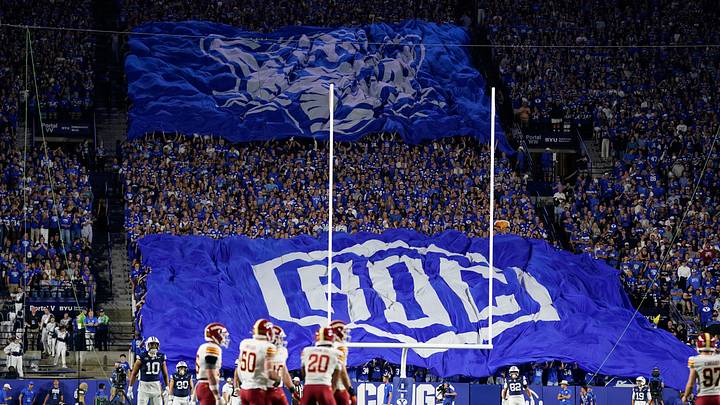
Now, let's think about what generally happens. The team that wins the coin toss chooses defense, and then the other team chooses the end of the field. This decision is often seen as trivial, but in many cases, it isn't. In many stadiums, the home team's student section is behind one endzone, and the section designated for fans of the visitting team is behind the other endzone. The majority of the time, the team losing the coin toss chooses the end of the field that's more favorable to them in terms of fan support. This means that usually, the team that gets the ball first gets to play close to where many of their rowdiest fans are.
So recently, I started hypothesizing, "What if the reason the team that gets the ball first wins a small majority of the time isn't because getting the ball first is an advantage by itself? What if it's actually because of the fans?" If this is true, it would suggest that in many cases, the optimal strategy is something nobody has been doing, not even Holgersen or Sanders: instead of choosing offense or defense, choose the end of the field with your fans.
If there's any situation where this strategy has merit, it's at LaVell Edwards Stadium. The north end of the stadium is where most of the visiting team's fans are, and the south end of the field is where the ROC is. As many of you know, the ROC is one of the rowdiest student sections in the country, and while there are people like Arizona coach Brett Brennan who deny that it makes a difference, I think we all know that's not true.
Just in case there was any doubt that the ROC affects games, I went through every BYU home game in the Kalani Sitake era, and I found that of the 108 pre-snap penalties BYU's opponents have committed in Provo, 72 of them were south of the 50-yard line. That is exactly two-thirds. Plus, look at the last three overtime games BYU has played at home: Mississippi St in 2016, USC in 2019, and Baylor in 2022. In all three of those games, the deciding overtime was on the ROC end of the field with BYU getting the ball first, and BYU won all three games.
Of course, three is not nearly a big enough sample size to make any certain conclusions, so I decided to analyze every single college overtime game since 2020. For each game, I went through the play-by-play logs to see who got the ball first in each overtime, what each team scored in each overtime, and which team won. Unfortunately, most play-by-play logs don't tell you which end of the field the teams played on (which really goes to show how seldom people have even thought about what I'm talking about) so that necessitated a couple extra steps.
For every game, I asked Google's AI assistant whether or not there was an endzone that was more favorable to one team in terms of fan support and one that was more favorable to the other team. (I can't guarantee it always gave me the correct answer because doing the necessary work to verify it every time would've taken forever, but it did answer correctly when I asked this question about BYU, so I'm confident it was right at least most of the time.) Then, I found a video of each game just so I could see which side each team got the ball on in each overtime.
Yeah, this is by far the hardest I've ever worked on an article. But it was worth it if for no other reason then just to satisfying my nerdy curiosity. I hope this inspires you to lean into your own nerdiness.
Now, the reason I decided to go all the way back to 2020 was because I wanted a control group. I wanted to see what the percentages looked like when there weren't enough fans for the end of the field to make a difference. There were some games in the other years where the AI assistant told me there was no significant difference between the ends of the field in terms of fan support, usually because the fan section and the visiting team section were both next to the sidelines, not the end zones. But there weren't very many of these games, so I wanted to increase the sample, and I figured there was no better way to do it than collecting data from the one season where fans were basically not a factor in any of the games.
Here's what I found from the games where neither side was particularly more favorable than the other to either team: In games decided in the first overtime, the team that got the ball first was 20-19. However, in games decided in the second overtime, the teams that got the ball first in the second overtime were 6-15, including 2-5 in 2020. So apparently, if there are no fans, or if each end zone has about the same number of fans for both teams, it doesn't matter who gets the ball first in the first overtime, but the team that gets the ball second in the second overtime has a big advantage.
OK, now let's look at games where the fans were a factor, particularly those where one team chose to take the ball second and the other picked the end of the field with their fans. In the games decided in the first overtime, the teams that got the ball first on the side with their fans were 32-34. However, in games decided in the second overtime, the team that got the ball first on their fans' side in the second overtime were 23-9. So apparently, in the first overtime, having the ball first on your side is about as good as having the ball second on the other side, but in the second overtime, getting the ball first on your side is significatly better.
How does that make sense?
Here's one thought I had: When a game goes to a second overtime, the team that did not win the toss before the first overtime gets the option for the second overtime, and almost always, both teams choose defense first. This means that one of the teams gets two consecutive possessions: the second one of the first overtime and the first one of the second overtime. I'm guessing having to play two consecutive possessions on defense after having played an entire football game is exhausting. This could perhaps give the team that gets the ball first in the second overtime a significant advantage
However, you may recall that in the games where the fans weren't a factor, it was the team that got the ball second in the second overtime that had the massive advantage. In other words, in this scenario, having your defense on the field two possessions in a row is... a good thing?
Alright. Let me get this straight. In the first overtime, it doesn't really matter that much who gets the ball on what side regardless of the fan situation, but in the second overtime, getting the ball first on your side is a massive advantage, but getting the ball first when the sides are irrelevant is a massive disadvantage? How on earth can you explain this? What happens in the second overtime that all of a sudden makes the fans more important?
Perhaps it has something to do with the fact that in the second overtime, you have to go for two. With two-point conversions, which side of the field you're on can make a huge difference because you're really close to the fans, and they're usually especially loud.
But here's the thing: The two-point conversions in the second overtime only matter if both teams score a touchdown, and that only happened in 12 of the 56 games that went to double overtime. (Excluding 2020 because that was back when you didn't have to go for two until the third overtime.) Of those twelve games, only eight of them were decided in the second overtime, and the teams that went first were 4-4 in those games. So that wasn't a big factor.
I honestly don't have a perfect answer for this, but let me give you the best explanation I can think of with an analogy. You're running in a race where half of it is on concrete and the other half is on the beach. Running on the beach is much harder than running on concrete, and the more tired you are, the bigger the difference it makes. Now, would you rather run the first half on the concrete road and the second half on the beach, or vice versa? I would rather run on the beach first. That way, when I get to the halfway point, I get a boost instead of an extra burden. Psychologically, that sounds a lot better.
I'm willing to bet that for a lot of teams, playing on the favorable side of the field feels like running on concrete, and playing on the less favorable side feels like running on the sand. As we've established, the second overtime is usually played on the opposite end of the first. If you're going from the more favorable side to the less favorable side, it probably feels like going from running on concrete to running on the sand, which doesn't feel very good. If you're going from the less favorable side to the more favorable side, that probably feels like switching from sand to concrete, which feels awesome.
Also, let's consider the fact that the team that's going from their side to the other side is also the team that has to play two defensive possessions in a row. That means their switch from the more favorable side to the less favorable side is sudden, which could be brutal, especially if they're exhausted, which they probably are. But if there is no side that's necessarily more favorable than the other, that sudden switch doesn't happen.
So that's the best explanation I can think of. But when it comes to determining whether or not a team should choose the end of the field instead of going on defense, there's one more thing we need to consider. Let's say we win the coin toss and choose the end of the field. We presume the other team will choose to go on defense, so we'll be going first on our side. Then, if the game goes to a second overtime, the other team will get the first option, and they'll probably choose defense again. We will of course choose our end of the field again, so we will once again get the ball first on our side.
Or, let's say we lose the coin toss, the opponent chooses defense, we choose our end of the field, the game goes to a second overtime, we choose our end of the field, and they choose defense. Either way, we get the ball first on our side in both overtimes. That means neither team will have those back-to-back possessions on defense or the shock of switching from the more favorable end to the less favorable end. Then again, running on the concrete the whole race sounds a lot better than running on the sand the whole race, so maybe this option still makes sense.
I think it's fair to conclude at this point that if the game goes to double-overtime and you get the first option, and there's a side of the field that's more favorable to you, you should pick that side instead of choosing offense or defense, especially considering that in the first overtime, your opponent would've had the first option, which probably resulted in you getting the ball first on your side. If this is the case, choosing defense first will result in your defense having to defend two consecutive possessions while switching from concrete to sand. Choosing the end of the field instead helps you avoid this disadvantage.
Now, when it comes to the first overtime, the choice isn't as clear because not only is the data more even, but you don't know whether or not the game is going to a second overtime. I'm going to say it depends on how big the difference feels between one side and the other. If it doesn't feel like it's making too much of a difference, I would say just go on defense like everyone else. But if you're BYU playing at LaVell Edwards Stadium, I'm pretty sure your odds are better if you pick the south end regardless of what the data says about games in other stadiums, and if you're the visiting team at LaVell Edwards Stadium, I'm equally confident you're better off picking the north end.
One more thing I will add is that while I didn't really look too deeply into games that went beyond the second overtime into the two-point-conversion shootout, I think there's an especially strong case for picking the end of the field instead of choosing to go offense or defense first during the two-point conversion shootout. Going second doesn't give you any helpful information like it does in the first two overtimes. If your opponent converts, you want to convert, and if your opponent doesn't convert... you still want to convert. Considering how close you are to the fans when you do two-point-conversions, choosing the end with your fans feels like a no-brainer.
Are you convinced that the strategies I'm suggesting are correct? Maybe, maybe not. It's entirely possible that I just confused you by over-explaining everything. But I'm willing to bet that I've at least convinced you that this decision is not nearly as straightforward as you previously thought and that you don't have to be an idiot to go against the conventional wisdom. That's true for a lot of things. Just because someone does things differently than most people doesn't mean they're stupid.
Speaking of which, as I always say at the end of every article, remember to be kind to the officials.
 Add us as a preferred source on Google