

Computer rankings. A tool meant to evaluate teams in an unbiased way. Is that really possible though? I mean, you have to account for strength of schedule, but how do you evaluate a team's strength of schedule in an unbiased way? In order to do that, at some point, you have to have some sort of preconceived notion of how good each team is, right?
Let's take ESPN FPI for example. According to an article by ESPN Sports Analytics, in the preseason, FPI looks at four main things: prior performance, returning starters, recruiting rankings, and coaching tenure, all of which are subject to bias, and none of which I think should be factors in determining who should make the college football playoff. Throughout the season, as more and more data is collected from the games, these factors all become less and less important in the FPI rankings, but they never go away completely. They continue to be the baseline for calculating strength of schedule. At no point does it become 100% based on what happens on the field.
Of course, what we have to remember is that the purpose of ESPN FPI is to predict games, not to determine where each team should be ranked. Last season, after week 1, Texas was number 1 despite losing to Ohio St. It made sense from a predictive standpoint because Texas outgained Ohio St by 133 yards, and that's one of the big things you look at when you're trying to predict games. But when you're trying to determine who is going to the college football playoff, it should be about who won the game, not about the stats.
OK, so what about a ranking that's designed to determine who the most deserving team is? Let's look at ESPN's strength of record. According to another ESPN article, for each team, SOR measures how hard it would be for the average top 25 team to have a that team's record or better. I really like this ranking. However, it does have to account for strength of schedule, and how does it do that? By using FPI. So it is still affected by recruiting rankings and performance in past seasons and stuff like that.
But what if there was a way to rank teams that only evaluated a team's strength of schedule by how their opponents have done on the field in the current season? There is one called the Comparative Performance Index. The only factors it takes into account are your record, your opponents' records, and your opponents' opponents' records. The problem is that it doesn't account for your opponents' opponents' strength of schedule, so it's a little biased in favor of G6 teams because many of their opponents' opponents' opponents are in their conference.
However, what if we didn't stop there? What if we looked at a team's record, their opponents' records, their opponents' opponents' records, their opponents' opponents' opponents' records, their opponents' opponents' opponents' opponents' records, and so on? I decided to create a ranking that does just that. I call it the Higinbotham rankings. (But you can call it the Spencer rankings if you can't pronounce Higinbotham.)
Here's how the Higinbotham rankings work: I input every FBS team's 2025 record and schedule into Excel. I decided to only do the regular season games and not the conference title games or bowl games because I wanted to see where each team should've been ranked going into champ week. I erased all the FCS games and subtracted one win from each team for every FCS game they had, which meant that teams weren't rewarded for beating FCS teams, but they were punished for losing to them. (Hilariously, this resulted in UMass having -1 wins. I did have to manually go in and change it to 0.)
In the first iteration, each team's rating was their win percentage raised to the 0.65 times their opponents' win percentage raised to the 0.35. Then, it the second iteration, it was their win percentage raised to the 0.65 times their opponents' average rating from the first iteration raised to the 0.35. In every succeeding iteration, it was the win percentage to the 0.65 times the opponents' rating from the previous iteration raised to the 0.35. I kept doing this until every team's rating reached an equilibrium.
Here's the top 25 that I came up with:
Rank | Team | Win % | SOS | Rating |
|---|---|---|---|---|
1 | Ohio St | 100% | 0.495 | 0.782 |
2 | Indiana | 100% | 0.482 | 0.775 |
3 | BYU | 90.9% | 0.557 | 0.766 |
4 | Georgia | 90.9% | 0.506 | 0.741 |
5 | Oklahoma | 81.8% | 0.583 | 0.727 |
6 | Oregon | 90.9% | 0.479 | 0.726 |
7 | Texas A&M | 90.9% | 0.458 | 0.715 |
8 | Texas Tech | 90.9% | 0.455 | 0.713 |
9 | Ole Miss | 90.9% | 0.448 | 0.709 |
10 | Alabama | 81.8% | 0.534 | 0.705 |
11 | North Texas | 90.9% | 0.438 | 0.704 |
12 | James Madison | 90.9% | 0.421 | 0.695 |
13 | Notre Dame | 83.3% | 0.492 | 0.693 |
14 | Navy | 81.8% | 0.492 | 0.685 |
15 | Miami | 81.8% | 0.486 | 0.682 |
16 | Utah | 81.8% | 0.475 | 0.676 |
17 | Michigan | 75% | 0.537 | 0.667 |
18 | Vanderbilt | 81.8% | 0.457 | 0.667 |
19 | Tulane | 83.3% | 0.439 | 0.666 |
20 | USC | 75% | 0.532 | 0.665 |
21 | Virginia | 81.8% | 0.452 | 0.664 |
22 | Texas | 75% | 0.499 | 0.650 |
23 | Arizona | 72.7% | 0.502 | 0.638 |
24 | USF | 72.7% | 0.496 | 0.636 |
25 | UNLV | 81.8% | 0.385 | 0.628 |
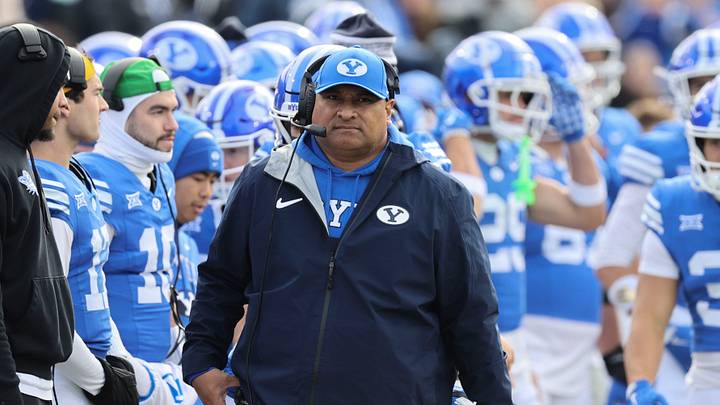
Wait. BYU's number 3? How is that possible?
Oh wait, it's because these rankings were created by a BYU fan. Never mind. He probably just gave BYU some sort of boost or something.
No I didn't. The only boost I gave anyone was the one I mentioned earlier that I gave to UMass. Once you evaluate each team's strength of schedule solely based on what happens on the field, BYU has the best strength of schedule of all of the one-loss teams.
Now, there are a few things to keep in mind: One, this was before champ week, so this isn't accounting for BYU's second loss to Texas Tech. Two, this doesn't account for style points, which helps BYU because they had a lot of close games. Remember, the goal is to determine who the most deserving teams are, not who the best teams are. Three, every game is weighted equally, and whether you beat team A and lost to team B or beat team B and lost to team A doesn't make a difference. This meant Miami's win over Notre Dame wasn't blown out of proportion like it was in the CFP rankings.
Considering that BYU's opponents (not including Portland St) were a combined 77-55, including 76-44 against teams that weren't BYU, and that the Big 12 was overall on par with the Big 10 and not that far behind the SEC in terms of what actually happened on the field in the regular season, it makes sense that their strength of schedule was so good. For many teams at the top of the rankings, their opponents had a losing record.
So what does this mean about where BYU should've been seeded? While I do agree that teams shouldn't be penalized for losing their conference title game since that could incentivize conferences to get rid of their title games, I do think that after losing to Texas Tech in the Big 12 title game, it would've been fair for Texas Tech to pass them up, and it would've also been fair for Georgia to pass them as a reward for winning the SEC championship game because rewarding teams for winning the title game is just as important as not punishing them for losing. So that would make BYU the 5 seed.
After making all the appropriate adjustments based on what happened in the title games, here's what the CFP field would've looked like if it had been based on the Higinbotham rankings
8 Texas A&M vs. 9 Ole Miss
5 BYU vs. 12 Tulane
7 Oregon vs. 10 Alabama
6 Oklahoma vs 11 James Madison
1 Indiana vs. Texas A&M/Ole Miss winner
4 Ohio St vs. BYU/Tulane winner
2 Georgia vs. Oregon/Alabama winner
3 Texas Tech vs. Oklahoma/James Madison winner
I hope you enjoyed this. Once we're about halfway through the 2026 season, I'll probably start publishing my rankings every week. As always, remember to be kind to the officials.
 Add us as a preferred source on Google