

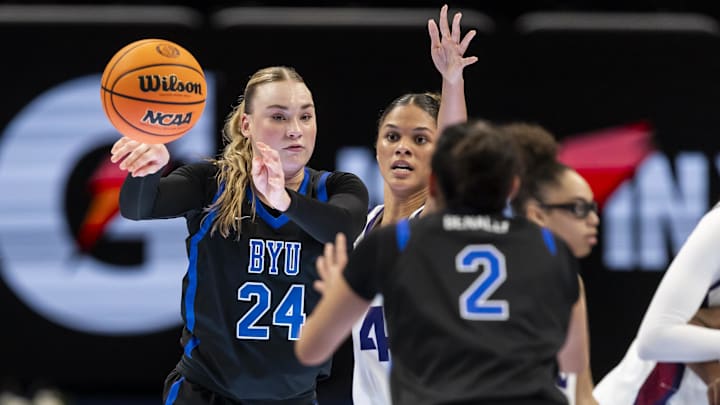
Imagine you're coaching a basketball team, and someone tells you they will pay you and each of your players 2,000 dollars, but they will deduct 100 dollars for every turnover your team commits. You care more about getting as much money as you can than you do about winning the game. What would your strategy be? This is what I would tell my players: every time you get the ball, slowly take it close enough to the basket that you can shoot it without anyone mistaking it for a bad pass, and then just huck it up. We would lose by 100 points, but we would all be 2,000 dollars richer.
Last season, according to the Big 12 website, the BYU women's basketball team averaged 17.0 turnovers per game, and they finished the season 13-17 with no postseason. Just about anyone would've said that in order for the Cougars to improve, they needed to cut down on turnovers. But they would've been wrong. This season, BYU is averaging 17.2 turnovers per game, which is slightly more, and yet they're 22-11 and on the NCAA tournament bubble. How is this possible?
Let's think about this abstractly. In basketball, there are essentially four ways a possession can end: a made basket, free throws, a miss and a defensive rebound, or a turnover. Obviously, the first two are more desirable than the last two. I am not debating that. But I've noticed that a lot of fans, broadcasters, and coaches react with more disgust when their team turns it over than when their team misses and fails to get the rebound. I myself tend to do this. But let's think about this. Either way, you get 0 points, so why is one worse than the other?
I think we tend to think of turnovers in basketball similar to the way we think about them in football. In football, a turnover can be absolutely disastrous, not because you get any fewer points than you do with a punt or any other kind of stop, but because you usually give your opponent really good field position, which increases their odds of scoring. One might argue that when you turn it over in basketball, you also increase your opponent's odds of scoring. But is that actually true?
To find out, I did a statistical analysis involving BYU women's basketball. Using StatBroadcast, I went through each and every one of BYU's games this season and recorded how many turnovers BYU had, how many points their opponent scored on those turnovers, how many total points their opponent scored, and how many possessions their opponent had. I ran the numbers and found out something that completely changed the way I think about basketball. BYU's opponents average 0.815 points per turnover and 0.896 points per possession overall. That's right. When BYU turns it over, their opponents average fewer points than they do on all their other possessions. Take a moment to let that sink in.
This may seem impossible at first, but the more you think about it, it makes sense. While live-ball turnovers often lead to fast-break opportunities, which may indeed yield a higher point average than most possessions, this is not the case for dead-ball turnovers. Because play stops for dead-ball turnovers, you actually get a much better opportunity to set your defense than you do after missing a shot and not getting the rebound, so you actually give up fewer points on average.
Now, obviously, I'm not trying to argue that you should just turn it over every possession on purpose. You still want as many of your possessions as possible to end with a made basket or with free throws. But you don't have to be so afraid of turnovers that you play conservatively and not aggressively. BYU has been playing more aggressively this season than they were last season, and while that has increased their average turnover number from 17.0 to 17.2, my calculations, which could be slightly off, suggest that their average number of possessions that have ended with misses and defensive rebounds has gone down from 24 to 22.8.
Now, the average number of possessions ending with made field goals has gone down from 25.3 to 24.4, but the number of possessions ending with free throws has more than made up for that, and that's where BYU's aggressiveness has really paid off. Their average number of free throw attempts per game has gone up from 13.2 to 18.3, and as a result, their number of free throws made per game has gone up from 9.2 to 13.1.
This all illustrates a principle that applies not only to basketball but to everyday life. We don't have to be so afraid of making mistakes that we live conservatively. We should be bold and take chances, and while that may lead to us making more mistakes, it will also lead to us doing more good in the world and having more happiness.
 Add us as a preferred source on Google