

Perhaps we were the unrealistic ones for believing the first round of College Football Playoff rankings would be different from the fiasco we saw last season. Because the first CFP rankings were released yesterday, and they are a disaster in every sense of the word.
And I've got a lot to say about this topic. Perhaps in a few weeks, after the initial dust has settled, all of this griping will look silly. The dream of 3 Big 12 teams in the playoff is not technically dead yet, after all, and I'd happily accept two teams representing the league as a consolation prize. But the current state of college football has me suspecting that the CFP committee is sharpening their knives and impatiently waiting for one of the Big 12 teams to slip, giving them a reason to slash their playoff dreams.
It's infuriating to see the generous treatment directed toward the SEC in contrast.
When asked the committee's reasoning for lifting 2-loss Alabama to the fifth spot, Yurachek had this to say.
"It really came down to the quality of teams that Alabama has played and the quality of their wins," he explained. "They've got a win on the road against the team we had ranked sixth. They've got a win versus South Carolina, a team we have ranked 21st. They have a win at Mississippi State when Mississippi State was at 4-0 at full strength with that dynamic quarterback that Mississippi State had earlier in the year, and Alabama has had seven of their eight games against teams that have a .500 record or better, and I think that's what's separated them from an undefeated UCLA or a one-loss team in BYU."
The reasoning for the current state of the top-12 is horribly inconsistent -- at least as far as equal consideration is concerned. What is consistent are the inflated rankings for SEC members, who are ranked higher than their current AP Poll positioning across the board. Not a single SEC team saw their ranking worsen in the transition of power over to the CFP selection committee.
SEC teams are praised for their quality wins and given grace for their losses. All others are not afforded the same luxury under the College Football Playoff's rule.
Not even Notre Dame, a program that the committee has made an example of in the past two seasons despite their prestige, has been as favorably ranked as the five SEC Teams ranked ahead of them (including three two-loss programs).
"In regards to Notre Dame, to date an impressive 7-1 record, although their wins don't stack up against other teams we have higher in the rankings, as they currently own one win against a team with a .500 record or better. Notre Dame has faced one opponent in the top 25 so far; that was BYU on the road, and they did not win that game
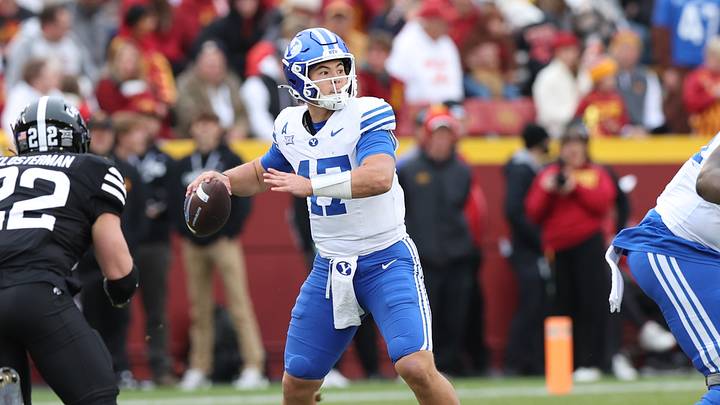
Alabama is praised for their win over Mississippi State, while BYU's victory over Notre Dame is only held against the Irish -- rather than a feather in the Cougars' cap. This reasoning is entirely too reminiscent of 3-loss Alabama being granted entry last season, with the committee's rationale primarily citing a "gutsy" call on fourth down in the SEC championship game.
Second-ranked Georgia is essentially unscathed after their home loss to 4-4 Auburn. BYU has plummeted to 9 for a road loss to 4-4 UCF in double-overtime.
Reigning champion Indiana is ranked fourth overall despite a resume that features zero top-25 wins and one loss. Undefeated UCLA -- Indiana's peer in the Big Ten Conference -- is ranked 8th with one top-25 win.
Not to be a conspiracy theorist about this, but it feels very obvious why ESPN would prefer a committee of voters over an objective statistical model. A group of human beings hidden behind closed doors, with absolute power and no checks, is free to bend the sport to their will, granting entry to the teams they see fit, regardless of logic or equality.
5 SEC teams in the field is good for business -- smaller athletic programs with smaller fanbases aren't.
The Big 12 Conference will be a 1-bid league in the 2026 College Football Playoffs
The only Power Four conference to never send an at-large team to the 12-team College Football Playoff, the Big 12 Conference will once again be a 1-bid league if the CFP selection committee can help it.
When you consider the reasoning behind their rankings, the logic begins to fall into place.
The CFP committee is ranking now to justify their intended results at the end of the season. Those intended results include an SEC-heavy field, and a one-bid Big 12 Conference. They laid the blueprint out last season.
No SEC team has even reached the championship round in the 12-team playoff format, yet the league heavily tied to ESPN, the corporation that also owns exclusive rights to College Football Playoff coverage including the rankings reveal show, continues to receive the benefit of the doubt, so far as to include three two-loss teams at this stage in the season.
Last year's initial rankings also featured three two-loss teams, ranked 10th, 11th, and 12th. This year's slate boosted those two-loss squads to 5th, 7th, and 10th. All of which are -- you guessed it -- SEC-affiliated.
The Big 12's second playoff team, BYU, has been dropped from 7th to 9th. With just one high-profile contest on their schedule, a road game against (3) Utah this weekend, the Cougars are suddenly thrust into a do-or-die scenario with a resume that stacks up favorably to (2) Georgia, (4) Indiana, (5) Alabama, (6) Kentucky, and (7) Texas. A loss to a .500 team is a death blow for BYU, a team ranked as high as 2 in the AP Poll this year, but a mere scratch to Georgia, whose loss to Auburn has been effectively forgotten.
The Big 12's third team, Texas Tech, has just one loss but is locked well outside the top 12 at 15th.
What happens to BYU in the realistic possibility that they lose to Utah? Last season, losses to the 4th-ranked Red Raiders kept the Cougars out of the playoffs, even with a win against top-15 Utah.
Add a loss to UCF on top of a Holy War defeat, and there's no logical consistency in hoping for a BYU at-large berth. Give Utah a home loss to ninth-ranked BYU and a loss in the Big 12 championship game, and they're in a nearly identical situation to last year's BYU team. Again, no logical reason to assume a different result.
Then again, logic really has nothing to do with college football, does it?
 Add us as a preferred source on Google