

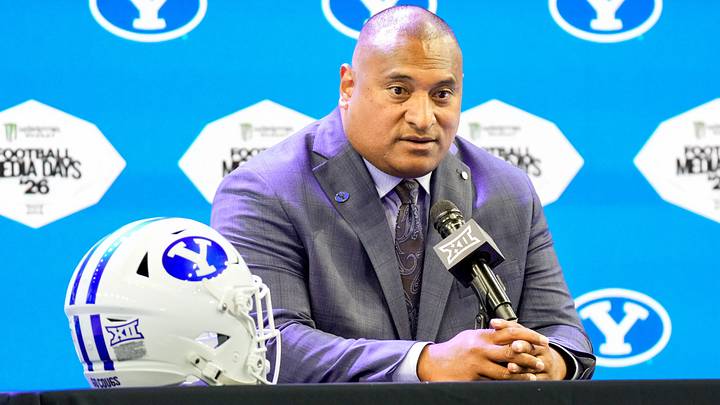
Kalani Sitake holds pride in his team being a developmental program. The Cougars' staff likes to identify high school talent, get them into the program, help them adjust to the unique lifestyle of a BYU student, then over the course of years turn them into stars.
As the Cougars prepare to kick off the 2026 season, one side of the ball is following Kalani's developmental approach while the other has embraced the transfer portal.
BYU's defense is mostly home-grown development
If coach Sitake loves him some home-grown talent, he's got to love what BYU's defense looks like in 2026. While the depth chart isn't official, those of us who follow the program know who the primary contributors will be. Here's how many of them have been developed solely at BYU versus those who joined as transfers:
Key home-grown key talent - 14 Players: DE Bodie Schoonover , DE Viliami Po'uha, DE Hunter Clegg, DE Nusi Taumoepeau, LB Isaiah Glasker, LB Siale Esera, LB Ace Kaufusi, CB Evan Johnson, CB Therrian Alexander, CB Jonathan Kabeya, CB Cannon DeVries, S Faletau Satuala, S Raider Damuni, S Tommy Prassas
Key transfer talent - 7 Players: DT Keanu Tanuvasa (Utah), Justin Kirkland (Oklahoma State), DT Anisi Purcell (SUU), DE Tausili Akana (Texas), LB Cade Uluave (Cal), LB Jake Clifton (Kansas State), CB Jayven Williams (Mississippi State),
By my count, BYU's defense sports a 2-to-1 ratio of expected key players this year with 14 being home-grown talent and seven arriving via the transfer portal. What's most noteworthy is the success the Cougars have had recruiting, signing, then developing talent at cornerback. For decades corner had been the Achilles heel of BYU recruiting, and now they have four really good home-grown studs in Johnson, Alexander, Kabeya, and DeVries.
Most of BYU's beef in the defensive trenches has come via the transfer portal with defensive tackles Tanuvasa, Kirkland, and Purcell having started their college careers elsewhere.

BYU's offense = Mostly tapping the transfer portal
On the flip side, BYU's juggernaut of an offense has primarily been assembled by putting pieces together from the transfer portal.
Key home-grown talent - 6 players: RB LJ Martin, RB Sione Moa, WR Jojo Phillips, WR Legend Glasker, G Sonny Makasini, C Bruce Mitchell,
Key transfer talent - 10 players: QB Bear Bachmeier (Stanford), WR Kyler Kasper (Oregon), WR Reggie Frischknecht (Snow), WR Tiger Bachmeier (Stanford), TE Roger Saleapaga (Oregon), TE Walker Lyons (USC), T Andrew Gentry (Michigan), T Paki Finau (Washington), G Kyle Sfarcioc (SUU), Zak Yamauchi (Stanford)
Of the 15 anticipated key players on the offensive side of the ball, two-thirds (10 of 15) arrived in Provo via the transfer portal. Kudos to BYU's staff for being able to recruit difference makers at nearly every offensive position. And, yes, Bear Bachmeier is technically a transfer from Stanford since he enrolled there and participated in team activities as a freshman before ultimately hitting the transfer portal and coming to BYU.
And additional kudos to BYU's staff for landing talent from traditional powers like Oregon, Michigan, USC, Washington, and USC.

The final summary
In all, of the 37 players who are expected to make the biggest impact this year, 20 are home-grown and 17 are transfers.
That's approximately a 55-45 split between those who have always called BYU home when compared to those who found their way to Provo via the transfer portal. This ratio provides a good blend of roster continuity and keeping the right team culture while also sprinkling in guys via the transfer portal who can make immediate impacts this year, such as WR Kyler Kasper, TEs Roger Saleapaga and Walker Lyons, and LB Cade Uluave.
BYU has built a strong roster through home-grown and transfer portal talent.
Now it's time to go out and have a legendary season.
 Add us as a preferred source on Google