

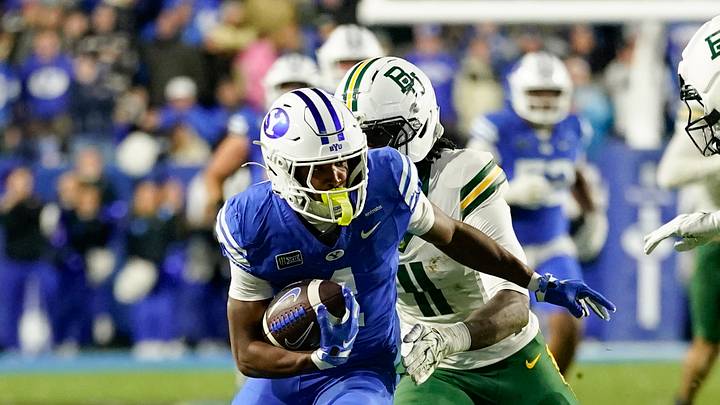
If you had told just about any BYU fan that they were going to beat Baylor by 21 points, we would've been thrilled. And yet, there was something unsatisfying about the win. After a tremendous first half, it felt like BYU let their foot off the gas in the second half. Not only did this create a little bit of worry that Baylor would come back to make the game interesting, but also, knowing how much this year's CFP committee cares about style points, and BYU having been left out last year because of their lack of style points, it felt like there was more BYU could've done.
This game got me thinking. Why is it that regardless of how each BYU game starts, they always end up being at least somewhat close? Does BYU play better when they're trailing than when they're leading?
To find out, I decided to do another one of my nerdy BYU fan things. I went through each and every score of BYU's first ten games of the 2026 season. For each BYU score and for each opponent score, I determined whether BYU was leading, trailing, or tied before the score was made. I tallied up how many total points BYU and their opponents scored in each of those three scenarios.
One thing I will clarify is that I technically could've evaluated extra points separately. For example, if BYU opened the scoring with a touchdown and made the extra point, even though the six points were scored when the game was tied, the extra point was technically scored when they were leading, so the 6 points and the 1 point would go in different categories. But I decided counting like that would be tedious and unnecessary, especially since neither BYU nor their opponents have missed an extra point all season, so I just counted all 7 points as one score. However, I did decide to count two-point conversions separately.
Let me walk you through the Notre Dame game as an example. (We might as well feel happy while I'm explaining.) BYU's first touchdown came with the game tied at 0, so that's 7 BYU points with the game tied. Notre Dame's field goal came with BYU leading 7-0, and BYU was still up 7-3 when Notre Dame scored a touchdown, so that's 10 opponent points with BYU leading. Then, BYU was trailing 10-7, and they scored a touchdown, so that counts as 7 BYU points while trailing, and then they were up 14-10 when they scored the next touchdown to make it 21-10, so that's 7 BYU points while leading.
Notre Dame then scored two field goals and a touchdown, all with BYU leading, so that's 12 more opponent points with BYU leading, but the two-point conversion happened with Notre Dame leading 22-21, so that's 2 opponent points with BYU trailing. Finally, BYU scored a touchdown while trailing 24-21, so that's 7 BYU points while trailing. In total, Notre Dame outscored BYU 22-7 while BYU was leading, BYU outscored Notre Dame 14-2 when they were trailing, and BYU outscored Notre Dame 7-0 when the game was tied.
So that's what I did with every game. I found that when BYU is leading, they're outscoring their opponents 159-138. When the game is tied, BYU's outscoring their opponents 76-26. When they're trailing, they're outscoring their opponents 72-18. Already, you can see that BYU's playing better when they're trailing.
But consider this: of BYU's 159 points while leading, 56 of them came against Utah Tech. Obviously, when a college football playoff contender is playing an FCS team that is currently 1-10, they're going to lead for at least most of the game, and they're going to score a lot of points while leading. So what if we exclude the Utah Tech game?
If we do that, then BYU is being outscored 131-103 while they're leading, and they're outscoring their opponents 69-26 when the game is tied. The tally when BYU is trailing is still 72-18 because they never trailed against Utah Tech.
Why is this? Why is BYU so good when they're trailing or tied and so mediocre when they're leading? This reminds me of Mario Party because there are several mechanics in that game that favor players low in the standings, such as better options on lucky spaces, higher probability of hidden blocks having stars, and players being less likely to steal your stars. But there's nothing like that in football. (Unless maybe you want to argue that some referees tend to favor the team that's trailing?)
I decided to take this a step further. I did the count again, but this time, I separated the scores into five groups: when BYU's leading by two possessions or more, when BYU's leading by one possession, when the game is tied, when BYU is trailing by one possession, and when BYU is trailing by two possessions or more. This is what I came up with:
BYU is outscoring their opponents 93-50 when leading by two or more possessions if you count the Utah Tech game and 44-43 if you don't. They're being outscored 88-66 when leading by one possession if you count Utah Tech and 88-59 if you don't.



They're obviously still outscoring their opponents 76-26 when the score is tied if you count Utah Tech and 69-26 if you don't. Regardless of whether or not you count Utah Tech, they're outscoring their opponents 66-18 when they're trailing by one possession and 6-0 when trailing by two or more possessions. (The only time they've trailed by multiple possessions all season was in the first half of the Utah game.)
My takeaway here is that BYU isn't just taking their foot off the gas when they actually have the game well in hand and it actually makes sense for them to take their foot off the gas. They're taking their foot off the gas even when they only have a one possession lead. Why is that?
Well, the conventional wisdom is that when you're trailing, you should go fast and throw the ball a lot to maximize how many possessions each team will get, and when you're leading, you should go slow and run the ball a lot to minimize the number of possessions. On defense, when you're trailing, you're supposed to play aggressively and take risks to force turnovers, but when you're leading, you're supposed to play conservatively and just try to prevent big plays at all costs.
This advice makes sense, particularly in the last 5 minutes of the 4th quarter. However, if you take this advice to an extreme and extend it to the first three quarters, it comes at a cost. Not only does it make you predictable, but it also prevents you from running your offense optimally. If you're only trailing by a few points in the middle of the second quarter, it's too early to abandon the run or to sprint to the line of scrimmage between every play, and you don't have to sell out on defense to force a turnover and risk giving up a big play. BYU's usually pretty good at avoiding that. But the other side of the coin is what's getting them.
What many people don't realize is that almost every team in college football averages more yards per pass than yards per run. BYU is no exception. According to cfbstats.com, BYU averages 7.8 yards per pass attempt and 4.8 yards per run, so theoritically, they should pass more and run less. When BYU's trailed, they've run the ball 62 times and passed 74 times. When they've been tied, they've run 65 times and passed 47 times. When they've had the lead, they've run the ball 230 times and passed 158 times. So the better the situation, the more they're doing what's giving them fewer yards per play.
Of course, there are some perks to running the ball. For example, the yardage you gain is more consistent, you're less likely to turn the ball over or get sacked, and it makes the clock run more, which is a perk if you're leading. Plus, if you completely abandon the run, that makes the defense's job easier. But up until the last few minutes of the game, none of these perks do anything to justify running more than you pass when you're 3 yards per play better on passes than on runs.
And then there's BYU's pace. According to teamrankigs.com, BYU ranks 126th nationally in seconds per play. As mentioned earlier, it does make some sense to drain the clock when you have the lead, but there are drawbacks. One, you're giving the defense plenty of time to catch their breath, substitute, and analyze your formation between plays. Two, it puts you in a lot of situations where you only have a few more seconds to snap the ball, which not only leads to delay of games, but also gives the defense a small window in which to expect the snap.
(And three, while it does give the opponent less time to catch up, it also gives you less time to get style points, which the CFP committee clearly cares about.)
Now, let's talk about the defense. As well as they're playing, they too have a tendency to let up a bit when there's even the slightest reason to play conservatively. Here are a couple examples:
First, the TCU game. As a whole, BYU's defense played lights out in this game. They only gave up two scoring drives. But look at when those two drives happened. The first one began with 3:51 to play in the first half with BYU leading 7-0. The second one began with 1:58 to play in the second half with BYU leading 17-7. In both cases, there was little enough time that TCU did need to pay attention to the clock and move with some urgency, but it's not like there was so little time that any play less than 20 yards was a win for BYU. It's possible that BYU was a little too conservative on those two drives.
The other example I want to highlight is the UCF game. Late in the fourth quarter, the game was tied at 24, and UCF had first and goal at the three. It felt like they were in the driver's seat because all they needed was three yards in four plays, and then they were going to be up a full touchdown. BYU's defense stood tall and made a miraculous goal line stand to keep the game tied. But then, in the first overtime, after BYU had scored a touchdown to put themselves in the driver's seat, it only took UCF one play to score from 25 yards. BYU's defense was great when they were on the ropes, but not so great when they had UCF on the ropes.
So here's my message to the BYU football team: no matter what the score is, unless it's the final few minutes of the game, play like you're trailing. Don't just take a small lead and then sit on it like Horton sitting on Mayzie's egg. You're not going to hatch a cougar bird. I'm not telling you to be reckless. I'm just telling you to recognize what's working and keeping doing it except when there's a very good reason not to.
As I always say at the end of every article, remember to be kind to the officials.
 Add us as a preferred source on Google