

While No. 8 BYU and No. 2 Notre Dame are only separated by six spots in the AP Poll, there's a gulf that separates them when it comes to talent, at least on paper.
The recruiting service 247 Sports publishes what's called a "Talent Composite" for every team, showing the number of 5-star, 4-star, and 3-star talents that dot every roster. When looking at raw talent based on recruiting stars, Notre Dame is in a different stratosphere than BYU. Here's the summary of talent for both teams:
Notre Dame talent composite (No. 6 nationally)
5-stars: 9 players (9%)
4-stars: 59 players (59%)
3-stars: 31 players (31%)
BYU talent composite (No. 59 nationally)
5-stars: 0 players (0%)
4-stars: 12 players (14%)
3-stars: 72 players (86%)
In summary, Notre Dame has 68 5-star and 4-star talents compared to BYU's 12. With teams starting 22 players on both sides of the ball, Notre Dame can go three deep at every position with 5-star and 4-star talents. There's a reason why the Irish have the No. 6 talent composite in the country, and their lineup is objectively stocked with premier talent.

To put this in context for BYU fans, when the Cougars landed 4-star safety Faletau Satuala a few years back it was one of the most celebrated high school signings in program history. Faletau sported a 94 rating from 247 Sports and was the No. 131 recruit in his class.
Notre Dame has 23 players rated 94 or higher, meaning they could in theory produce a 22-man starting lineup with every player at or above Satuala's talent rating.
The Cougars, on the other hand, have a total of five players who were rated 94 or higher coming out of high school with Tausili Akana (96), Andrew Gentry (94), Walker Lyons (94), Bott Mulitalo (94), and Satuala (94).
So do the Cougars even have a chance?
The talent gap between the Cougars and the Irish is vast, at least on paper.
But football games aren't played on paper.
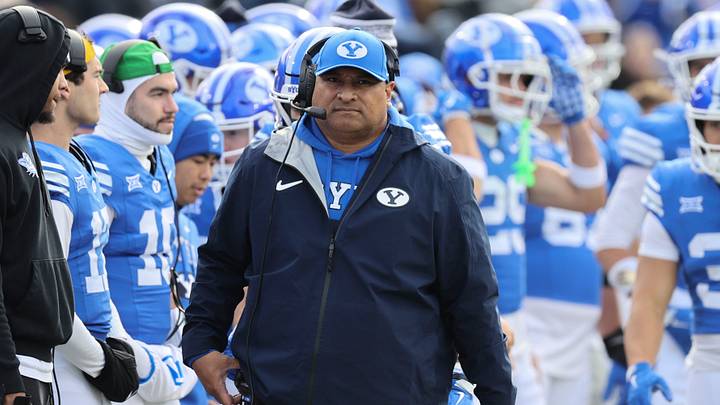
What talent composites don't account for are variables like coaching, player development, and culture. Under coach Kalani Sitake, BYU excels in all three of these categories. If there were objective, accurate rankings to measure coaching, player development, and culture, I wouldn't be surprised if BYU was a Top 10 team.

Talent composites also don't factor in variables like the reality of the "Vampire Cougs." Notre Dame is going to step into an environment in Provo on Saturday night that can rattle any player regardless of the number of stars next to their name in their 247 Sports profile.
What also gets lost in talent composites is that while boasting 68 5-star and 4-star players like Notre Dame, which is undoubtedly impressive, only 11 of them are on the field at any given time. And then those 11 need to work together in even smaller units that need cohesion and alignment.
Do all five of the offensive linemen know their assignments?
Is the quarterback in sync with his receivers and tight ends on the timing and depth of routes?
When linebackers drop into zone coverage, do they know when to pass off a receiver to the secondary?
And even if the players are doing their jobs, are the coaches installing the right game plans, calling the right plays, and managing downs and distances well?
Are players unified, engaged, and hungry enough to run through a brick wall for their teammates to get a win?
If the answer to all of the above questions is a definitive "yes", then teams with better talent composites should win the majority of the time. But that's not always the case.
For example, in 2025 LSU had the No. 6 talent composite and finished the season 7-6, including barely beating Western Kentucky 13-10. Last year Clemson had the No. 7 talent composite and also finished 7-6 with three of their victories coming against Troy, Furman, and Boston College. Penn State had the No. 10 talent composite, also finished 7-6, and fired their head coach.
While this No. 2 Notre Dame team is built different than last year's LSU, Clemson, and Penn State, those three teams remind us that talent composites don't by default translate into wins.
While Notre Dame's talent looks vastly superior to BYU's on paper, this game will ultimately be settled on the field.
 Add us as a preferred source on Google