

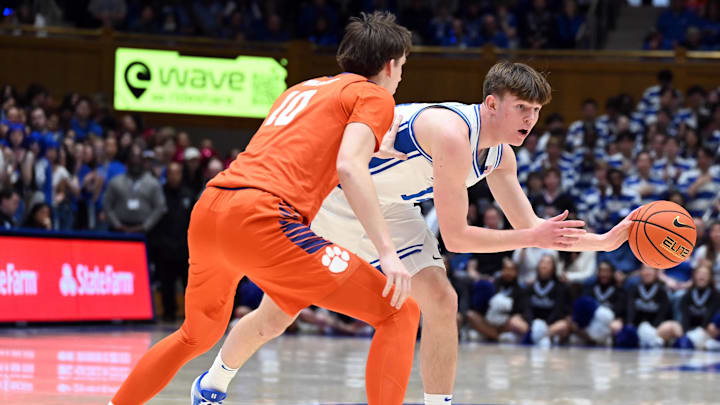
BYU's addition of stretch four Jake Wahlin from the transfer portal makes a lot of sense. He's LDS, a returned missionary, and originally committed to BYU out of high school before changing his mind and beginning his college career at Utah instead.
After BYU's loss in the first round of the NCAA Tournament, one of the first statements from coach Kevin Young was that his staff would be looking to add more 3-point shooting. At 6-foot-10, Wahlin helps fill that need to a degree after hitting 35% of his 3s two years ago at Utah, and 34% last year at Clemson.
But the real value Wahlin will bring to BYU is something not enough people are talking about.
Jake Wahlin has a secret superpower, and it's his efficiency has a defensive rebounder.
At time last year BYU gave up what felt like a ton of offensive rebounds and second chance points, even against inferior teams. And that was despite having senior Keba Keita who had been a solid rebounder throughout his time in Provo and emerging redshirt freshman Khadim Mboup who went after rebounds like a hungry junkyard dog.

Let's take a look at just how effective Jake Wahlin has been as a defensive rebounder and what this overlooked superpower might mean for next year's Cougars.
Jake Wahlin's excellent Defensive Rebound Percentage
The best way to evaluate a rebounder's effectiveness on the defensive glass is an advanced stat called "Defensive Rebound Percentage" (DRP). This stat estimates the percentage of available of defensive rebounds a player grabbed while they were one the floor. This stat essentially factors in variables like how many minutes per game a player plays and the pace of play in those games (i.e. the faster the pace, the more available rebounds.)
Let's take a look at Jake Wahlin's Defensive Rebound Percentage and what this could mean for the Cougars next year.
Last year in 18 ACC conference games Jake Wahin's DRP of 21.1, meaning he rebounded an estimated 21.1% of available defensive rebounds while he was on the floor. He ranked second on Clemson's team in conference play last year behind center Carter Welling at 25.4.
Let's now put Wahlin's Defensive Rebound Percentage in a BYU context.
In Big 12 play last year Khadim Mboup led the Cougars with a DRP of 24.3. Keba Keita trailed closely behind at 22.5.
In other words, last year Jake Wahlin's Defensive Rebound Percentage of 21.1 in conference play was only a whisker behind Keba Keita's 22.5. Keita, who was generally known as a solid defensive rebounder, ended his college career with a DRP of 23.0, so not much higher than Whalin's rebounding in ACC play last year.

While BYU fans are excited to welcome Jake Wahlin back home, much of the excitement has been linked to his outside shooting. And, yes, an innovative offensive mind like Kevin Young should be able to manufacture a host of open 3-point looks for Wahlin next year.
But where Jake might have the biggest impact for BYU is on the glass. As of now, the Cougs are in desperate need of rebounding next year. The team still needs to add at least two traditional centers at this point, and hopefully, at least one of them can inhale massive numbers of defensive rebounds and limit second-chance points from BYU's opponents.
But no matter how the Cougars address the center spot, Jake Wahlin and his hidden superpower of defensive rebounding will make BYU a better team.
 Add us as a preferred source on Google