

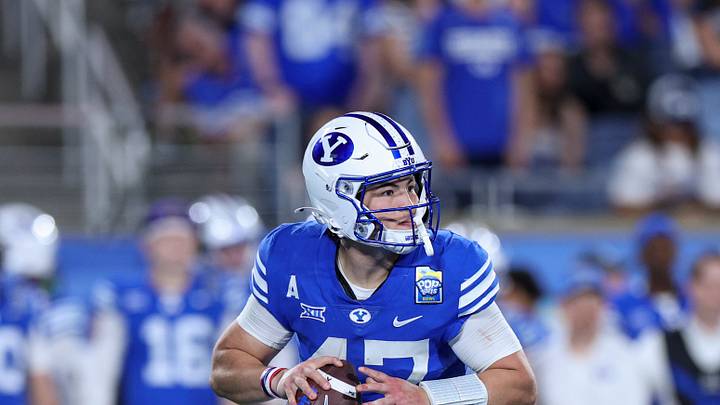
The college football season is beginning a week from Saturday. Wait, let me take a call. (Mm-hmm. Oh yeah. Thanks for reminding me.) It actually starts this Saturday with week 0. It's time for me to start using my formula to predict games. Man, I always work hard on this. Too bad I've never really had a way to share the results of my hard work with the general public. Oh wait? I forgot. I'm writing articles for Lawless Republic now. Now I can show off my hard work to thousands of people. Let's do this!
Let me explain how my formula works. I'm calling it the Higinbotham Predictive Rankings. For each team, I generate an offensive rating, which is how many points they would be expected to score against an average team, and a defensive rating, which is how many points they are expected to give up to the average team. All the stats I use come from teamrankings.com.
For the first week, these ratings are based on last year's offensive and defensive yards per play, last year's offensive and defensive plays per game, last year's strength of schedule according to the Higinbotham rankings I wrote about a couple weeks ago, which I will now start calling the Higinbotham Playoff Rankings, this year's returning production rankings according to ESPN, and this year's recruiting rankings and transfer portal rankings according to 247 Sports.
Starting week 2, I will also account for this year's yards per play, plays per game, and strength of schedule. Around week 6, I'll stop accounting for recruiting and transfer portal rankings and make it exclusively about what has happened on the field this season.
Once I generate the ratings, for each game, I use Team A's offensive rating and Team B's defensive rating to determine how many points Team A will score, and I use Team B's offensive rating and Team A's defensive rating to determine how many points Team B will score, and then I adjust for home field advantage. Notably, my formula doesn't account for unpredictable things like turnovers, penalties, points per yard, and special teams. The idea is to only include stats that are consistent and predictable.
Again, I want to emphasize the difference between the models we should use to predict games and the models we should use to determine who should go to the college football playoff. When you're making predictions, you look at things like stats, recruiting and transfer portal rankings, injuries, and success in previous seasons, and you weigh more recent games more heavily than earlier games, and you have to punish teams more for having bad stats in their conference title than in their other games because it's the most recent game. This is what the Higinbotham Predictive Rankings are for.
When determining who belongs in the college football playoff, none of that should matter. It should be simply about strength of schedule and winning your games, and you should be rewarded extra for winning your conference championship but not punished for losing it. This way, it's less of a biased fashion show and more about who scores more points than their opponents. That's what the Higinbotham Playoff rankings are for. You want to know what those rankings look like right now? Every FBS team is tied for first place because nothing has happened on the field yet.
With that said, let's see what the Higinbotham Predictive Rankings say about each of BYU's games this season. I'm unable to use them to predict the Utah Tech game because many of the databases I used only had FBS teams. I'm just going to eyeball this one and say BYU 48 Utah Tech 3 because we're talking about a college football playoff contender and an FCS team that went 2-10 last year. Here's what my predictive rankings say about the rest of the games:
Predictions for each BYU football game by the formula
BYU 27 Arizona 22
BYU 34 Colorado St 19
BYU 27 TCU 25
BYU 34 Iowa St 18
Notre Dame 31 BYU 22
BYU 26 UCF 23
BYU 29 Arizona St 22
Utah 29 BYU 27
BYU 34 Baylor 21
BYU 29 Kansas 23
BYU 34 Cincinnati 23
The good news is that assuming BYU beats Utah Tech, the Higinbotham Predictive rankings have BYU going 10-2. The bad news is that their two losses are to the teams I and many other Cougar fans want to beat the most. I would be happy to be wrong about the Notre Dame and Utah games.
Now let's look at what my formula says about some of the other important games in weeks 0 and 1. I'll include all the Big 12 games that aren't against FCS teams as well as any other games that seem important:
TCU 26 North Carolina 20
Virginia 30 NC State 23
Georgia Tech 32 Colorado 23
Miami 28 Stanford 19
Houston 34 Oregon St 19
Auburn 29 Baylor 21
Cincinnati 39 Boston College 23
Tulsa 30 Oklahoma St 22
LSU 28 Clemson 17
UCLA 27 Cal 26
Washington 32 Washington St 17
Ole Miss 28 Louisville 25
Notre Dame 35 Wisconsin 12
Florida St 33 SMU 24
I like to compare my predictions to the spreads and over/unders on the cbssports.com scores page, and most of my predictions are very close to those in terms of the spread and over/under. The one big exception in week 1 is Oklahoma St vs. Tulsa. I have Tulsa winning by 8, and they have Oklahoma St winning by 14.5. I guess nobody told my formula that Oklahoma St was going to go from 1-11 with no FBS wins last year to being a Big 12 contender this year the way everyone thinks they will just because they have the 15th best transfer portal class and the 71st best recruiting class. We'll see if that ends up happening.
Anyway, I'm thinking about making this a weekly series. Each week, I'll post my predictions for all of BYU's remaining games as well as all the Big 12 games and other important games of that week. (As soon as everyone's done playing cupcakes, I will have to raise the bar as far as what constitutes an important game.) I'll also follow up on my predictions from the previous week, and I may even do a little competition against Dick Harmon from the Deseret News, who has been doing weekly predictions for a long time. Spoiler alert: Almost every time I've done this in the past, I've absolutely crushed him.
 Add us as a preferred source on Google